On a recent afternoon in Detroit, Michigan, I discovered maps in some of the city’s most beloved destinations. Maps and spatial data are, of course, valuable components of many kinds of research, but it’s also exciting to see them used in other contexts, like art, entertainment, or storytelling. Each map I saw while out-and-about in Detroit has counterparts in the newly-redesigned BTAA Geoportal, and I enjoyed comparing the maps I found with Big Ten geospatial collections once I got home.
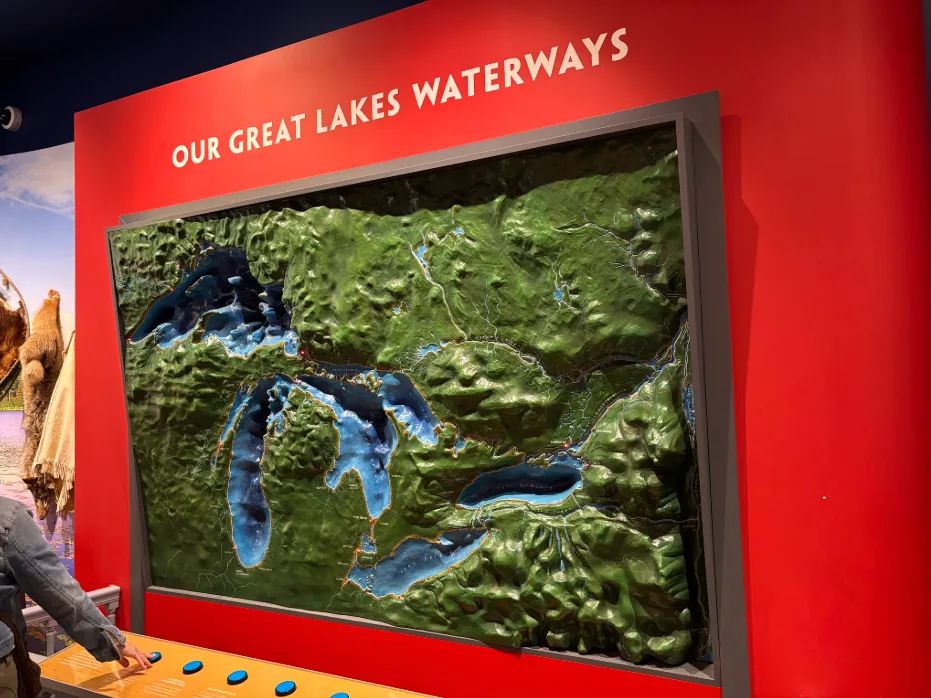
Belle Isle Park is a Detroit treasure. The 985-acre state park offers natural areas to explore, picnic and sports fields, and a number of cultural attractions, including a conservatory designed by Albert Kahn, the oldest aquarium in North America, and a historic marble lighthouse. Another feature of the island is the Dossin Great Lakes Museum, dedicated to the history of the Great Lakes and how people have navigated, worked, and enjoyed them over the past 300 years. Understandably, maps are an important tool for telling the story of the Great Lakes. One of the centerpieces of the museum is a large, interactive relief map of “Our Great Lakes Waterways”, which is at the entrance of a section dedicated to industry in the Great Lakes. Visitors can press buttons below the map to light up ports connected to the fur, iron and copper, grain, lumber, and gravel industries.(In the picture below, major fur ports are illuminated on the map.) You can find a variety of resources related to shipping in the Great Lakes and across the globe in the BTAA Geoportal, including downloadable datasets and digitized historic maps.
Raised relief map of the Great Lakes
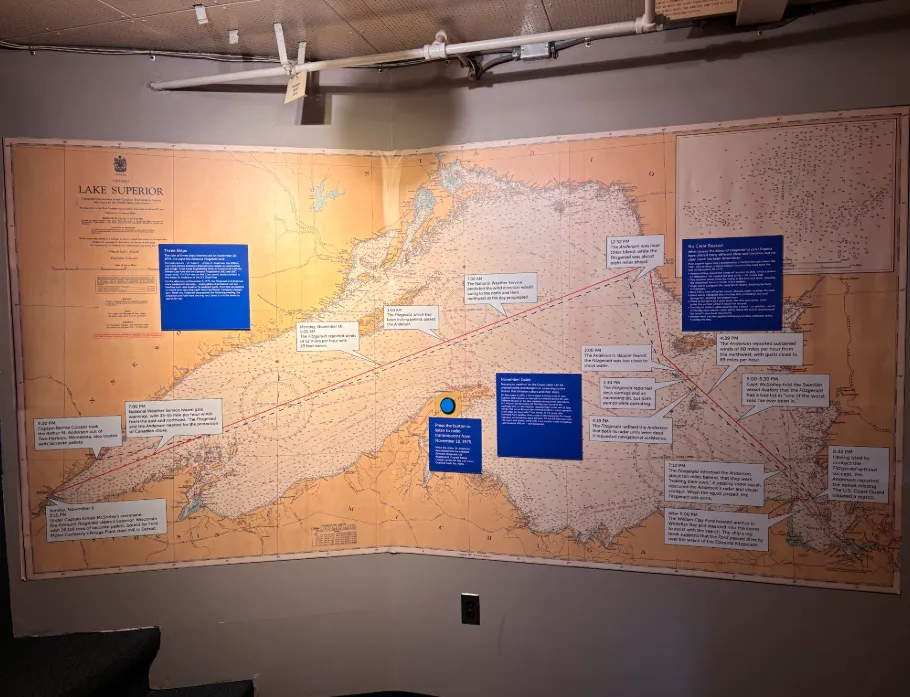
Deeper in the museum is the pilot house of the William Clay Ford, one of the first ships to go looking for the SS Edmund Fitzgerald on November 10, 1975. To convey how that night’s storm developed and the path of both ships, the museum uses a map. Below the Ford’s deck is an enlarged nautical chart of Lake Superior created by the Canadian Hydrographic Service and U.S. Lake Survey, with the Fitzgerald and Ford’s courses mapped onto them alongside timestamps of their communications. This nautical chart is the perfect base layer to concisely capture the Emdund Fitzgerald’s last night and just how dangerous storms on the Great Lakes can be. You can check out a 1919 version of that nautical chart in the BTAA Geoportal, or look through more digitized U.S. Lake Survey Nautical Charts.
Nautical chart of Lake Superior
Both of the above maps are important to the story their exhibits are trying to tell, laying out spatial and temporal change to museum visitors in an inviting and approachable way. But sometimes, maps in the wild are just plain fun! Elsewhere in the Dossin museum, pictorial maps of Belle Isle over the years are displayed to show visitors how the spot they are standing on has been enjoyed by Detroiters over the decades.
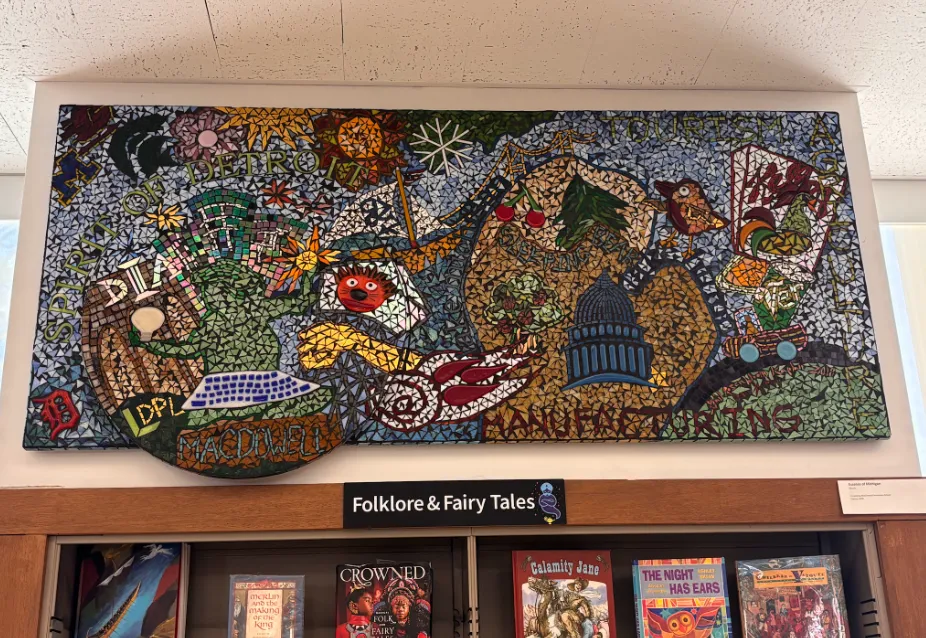
Maps-as-art show up prominently in another of Detroit’s cultural destinations: Detroit Public Library’s Main Library, on Woodward Avenue in the heart of downtown. Above the shelves lining the current children’s room are a variety of mosaics created by Detroit elementary students. Maps show up in a few different mosaics, but the most prominent one is in “The Essence of Michigan,” created by students of MacDowell Elementary School in 2018. Between the iconic Spirit of Detroit statue and a box of Kellogg’s cornflakes and surrounded by various professional and college sports logos (including two Big Ten schools: Michigan State and University of Michigan!), a pictorial map of the lower peninsula is featured, complete with cherries, an apple and pine tree, and the state capitol’s iconic dome.
Colorful mosaic
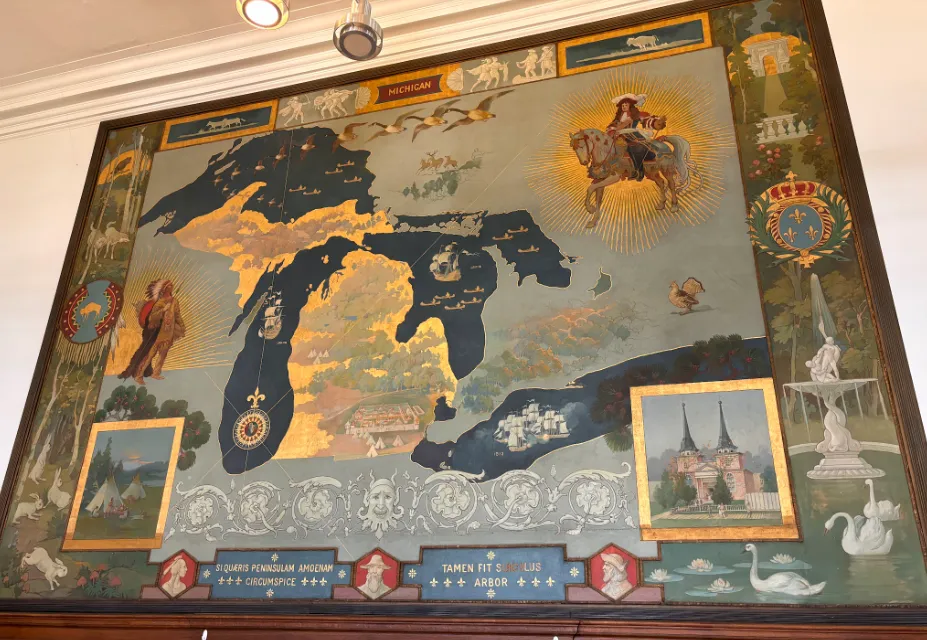
The MacDowell students’ pictorial map of Michigan is reminiscent of another popular work of art in the Main Library: Frederick J. Wiley’s pictorial map of Michigan, designed for the building’s original Children’s Room in 1923 (now the library’s teen room and a maker space). This massive pictorial map is painted in delicate colors and gold leaf, and depicts both peninsulas and the Great Lakes that surround them. An early version of Fort Detroit takes up most of the lower peninsula. The border is made up of various pictorial elements representing Michigan’s Indigenous heritage, its French colonial history, and the state’s flora and fauna. Wiley’s pastels and clean composition elegantly gloss over the violence of colonial conquest, a silence that was common in pictorial maps for much of the 20th century. While none of the scanned maps in the BTAA Geoportal are as large as Wiley’s, many striking pictorial maps have been added, including some of Michigan.
Colorful map of Michigan and the Great Lakes
These were just some of the maps I found during my afternoon in Detroit. We encourage you to keep an eye out for maps in the wild near you! And if you ever want to find a map without having to venture out and about, you can search the redesigned BTAA Geoportal anytime to find over 116,000 maps and datasets from across Big Ten collections.