
Collaborative Storytelling about Important Farmlands Maps Collection
The Donald W. Hamer Center for Maps and Geospatial Information at the Penn State University Libraries created a new display during the Fall 2025 semester that highlights the value of important farmlands maps. In addition, this project illustrates an example of engagement from student employees in a maps and geospatial center.
Components of the Important Farmlands Display
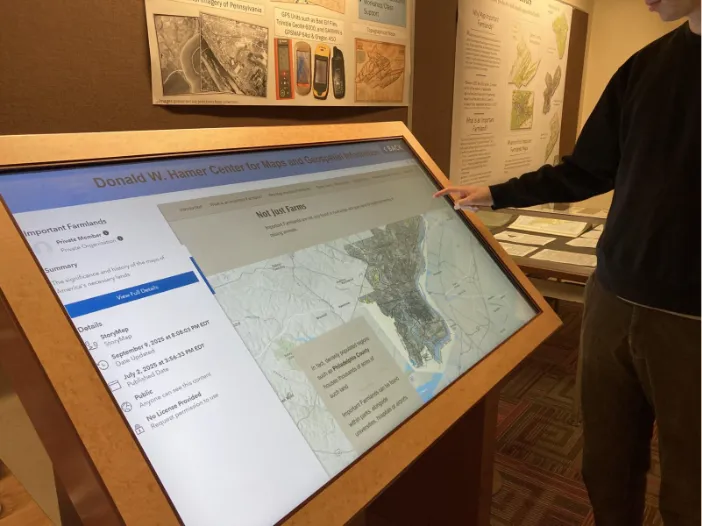
Components of the important farmlands display include the poster, an audio recording, a selection of related materials in the library collection, a StoryMap and associated maps and geospatial blog post on the display.
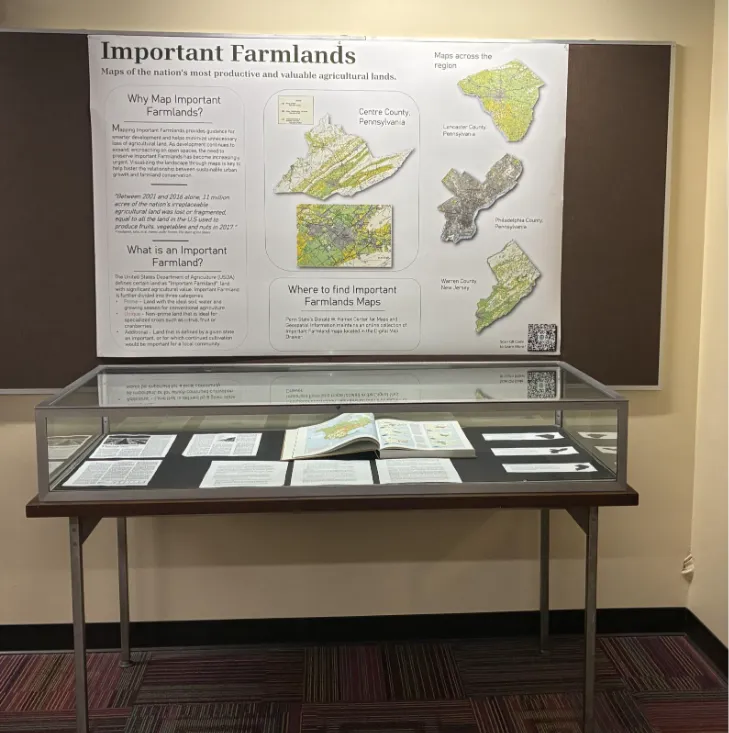
This display highlights items from the Penn State Libraries important farmlands maps collection, along with additional important farmlands maps from the BTAA Geoportal collection. For additional context of this collection, see the BTAA-GIN Important Farmland Map Collection post. Important farmlands maps from all over the country can be found within the BTAA Geoportal. Many such maps are available through digital collections and map drawers maintained by BTAA institutions. These materials support research on agricultural land conservation, land-use change, and policy related to Important Farmlands.
Elements of Student Employee Project Engagement: Project Planning
Part-time, student employees (Maps and Geospatial Assistants) and full-time staff spent months of the summer 2025 semester compiling research into an all-encompassing StoryMap that goes into extensive detail about the history, importance, uses, regulations, and advocacy surrounding important farmlands. The employees of the department worked collaboratively, drawing on each of their shared experiences and proficiencies with mapping software and ArcGIS tools. Throughout the process of this project, Maps and Geospatial Assistants leaned into their backgrounds, knowledge from courses, and interests.
During the early planning phases, we discussed the audience of the poster display and StoryMap; a general audience entering the space and those visiting the Maps and Geospatial website. The team discussed narrative structure early in the project’s development to ensure a focused, coherent story was drafted. A helpful resource on developing stories, included the Nine steps of great storytelling, by Allen Caroll, Esri StoryMaps team.
We then discussed who wanted to contribute and/or lead certain parts of the project knowing that certain aspects would require the use of specific skills related to poster design, StoryMap experience, experience with web map layer, media selection, development of an engaging narrative around the topic of important farmland maps, along with interest in developing a recording about the display. After the StoryMap was complete, a group of student-employees materialized the project in the form of the poster and display case within Penn State’s Pattee library. After creating the poster display and StoryMap, student employees compiled a script with accompanying visuals including many important elements from the poster display. The video was then recorded as a supplement to the poster display. Four Maps and Geospatial Assistant contributors to the important farmlands map StoryMap included Jeddiah Dreher, August Paterno, Michael Coupland, and Lucas Hower.
Throughout this project, Maps and Geospatial Assistants developed experience using important farmlands maps from the BTAA Geoportal, georeferencing with the Allmaps plugin, locating additional environmental layers of interest for context, and gained experience with Esri tools, such including StoryMaps.
Planning Future Student Employee Projects
This project can be scaled up or down depending on the resources available. This includes the selection of maps available to include and the extent of background research, along with the supporting StoryMap and selection of physical items. Depending on whether there is a physical space available or whether an online presence is preferred, aspects of this project could be selected depending on the needs of the particular library. Additionally, more display projects could be created in this format with various amount of content.
About the Authors
August Paterno (he/him) is a Graduate of Penn State in Geography and Economics. His interests include GIS, Urban Studies, and Statistics. August has been working at the Donald W. Hamer Center for Maps and Geospatial Information since April 2022.
Jeddiah Dreher (he/him) is a second year at Penn State majoring in Environmental Resource Management and minoring in Environmental Soil Science and Geographic Information Systems. His interests include landscape ecology, soil science, physical geography, and GIS. Jeddiah has been working at the Donald W. Hamer Center for Maps and Geospatial Information since June 2025.